Vaishnavi Pusapati is a physician writer and poet who currently works as a Poetry Reviewer for Consilience Poetry Journal. Her work spans from haiku to short stories, often exploring memory, identity, illness, and the quiet patterns of everyday life . A Touchstone Award and Welkin Prize longlisted writer, her work has appeared in the IHRAM Press, The Palisades Review, Roanoke Review, Havik, SoFloPoJo, Meniscus, Tyger Tyger, redrosethorns, among others. She teaches poetry workshops as well.
Dr. Vaishnavi Pusapati writes with a rare emotional clarity, exploring the ways memory, loss, longing, and identity shape our inner lives. Her work is marked by an elegant restraint, trusting implication over explanation and allowing quiet moments to carry extraordinary emotional weight. Moving seamlessly between the intimate and the philosophical, she examines the fragile architecture of human relationships with compassion, curiosity, and remarkable precision. Whether writing in prose or poetry, she possesses an instinct for distilling complex emotional experiences into language that feels both accessible and profound. The result is work that is contemplative, deeply affecting, and rich with the kind of insight that continues to resonate long after the final line.
We interviewed Vaishnavi about her piece, Mother, Mother: Purple bruises under purple drapes, published in The Palisades Review. Read that story here (page 35) and read her interview below.
TPR: What does your first draft typically look like? Are you someone who writes quickly and revises extensively, or do you labor over each sentence as you go?
Vaishnavi: My initial drafts are usually skeletal, and each revision adds layers. I usually overshoot the word limit I’d prefer and then start paring down the text, removing any excesses. Since I am primarily a poet who delves in haiku, free verse and blackout, I use the same techniques in non fiction as well. I would say that I write rather quickly, there has never been a period of not writing that felt too long. The laborious task is the decision of editing, taking away too much or too little, those many decisions.
TPR: How has your writing process changed over the years? Is there anything you once believed about writing that you've since abandoned?
Vaishnavi: My writing process has grown over the years. Initially, I was writing with a story in mind but now I let the writing happen and then work out the details. I underestimated editing in my early work. I now know the risks of over editing my work. I try to think of my work in pictures, to rule out any inconsistencies. More than before, I want the piece to have an internal voice, to be more than a story and to make a statement, to be memorable and uncommon.
TPR: Do you have any rituals or habits that help you enter a writing mindset, or do you write whenever and wherever you're able?
Vaishnavi: I like having stationery ready, having a blank page itself is stimulating to put thoughts down, even if nothing comes of it, I don’t want to lose a thought that could have been a line in my poem or story. I think journalling and reading contemporary literary journals has helped me understand when a piece is really finished.
TPR: What advice has most influenced your writing practice, and is there any advice you've intentionally chosen to ignore?
Vaishnavi: Copywriting iconic pieces really helped me get into the process of the writers I admire, contemplating on word choice, syntax etc. Blackout poetry has also helped me interact with the words around me effectively and efficiently. An advice I chose to ignore would be to write for the sake of writing, as a daily habit of practice etc., hoping something would come of it. Now I write only when there is a compelling picture or thought I really want to share and pursue.
TPR: What part of writing continues to challenge you, no matter how many pieces you complete?
Vaishnavi: I think dialogue and character interaction are difficult for me and I try to work around it if I can. I do not want to insert dialogue if it feels unnatural. I think I have abandoned that cause- of learning that part of the craft. I also struggle with longer pieces. I usually manage to cut them done to shorter versions that seem more complete and not stretched out.
TPR: "Mother, Mother: Purple bruises under purple drapes" compresses an immense amount of emotional experience into just a few paragraphs. How did you decide what to leave unsaid, and when did you know the piece had reached the point where adding more would actually weaken it?
Vaishnavi: I think a piece is ready when I can see it as a complete picture with a meaningful action within, a microcosm, and when I read it again and again I should like it more and more. I try to show, not tell, but at the same time I add the tools of metaphor and symbolism in order to bring action and life into the words.
I guess disassociating with the piece and reflection after some time helps me wonder if that point is truly reached. In the end, the characters should be familiar and their actions properly motivates and honestly conceivable. Only then the story is complete. I do not indulge too much in plot twists or ambiguity.
TPR: The opening image of viewing your mother from a top-floor window immediately establishes both physical and emotional distance. Did that image arrive first, or did it emerge through revision as a way of framing the piece?
Vaishnavi: The image was the first thing that came to my mind before I wrote the piece. As a haiku poet, images influence my poetic style that carries forward into my non fiction as well; and I prefer my work to be a bit observational. I trust the readers to contextualize the things left unsaid because an explanation would create a break in the continuity of the piece. I wanted the piece to play out in its raw urgency with as little interruptions as possible.
TPR: The piece moves fluidly between concrete observation and metaphor, often within the same sentence. How do you balance lyric language with emotional clarity so one never overwhelms the other?
Vaishnavi: I tried to witness the piece as an observer and as a poet I have tried to infuse my work with poetic direction, consciously or unconsciously. I think the balance is a constant fight between both the forces: language and emotion, for the space in between and I think trying to be honest in my character’s voice helped me find that cadence.
TPR: Within the piece, physical space—the home, its rooms, its objects—mirrors the narrator's internal landscape. How conscious were you of using place to reflect emotional change?
Vaishnavi: I wanted the place and the person to sync and make sense. The way we make a space our own is through the things we allow into our spaces. I really wanted the objects to reflect their owner’s state of being. There is a sense of exploring the boundaries of belonging: to places and things, a story behind each of them and I wanted their presence highlighted in the text.
TPR: This piece resists easy resolution, ending instead with an observation about the hidden lives people carry. What do you hope readers are left thinking—or feeling—after they reach the final sentence?
Vaishnavi: What happens within a person’s mind and home is always hidden and I wanted to capture that. We can only truly know a little about most people we interact with, even if they are relatives. There is a whole other aspect of their life, to which we are strangers. I hope the readers get a feel of walking in the protagonist’s shoes for a while, inhabiting her world, imagining her point of view and then perhaps also reflect on the opening sentence again.
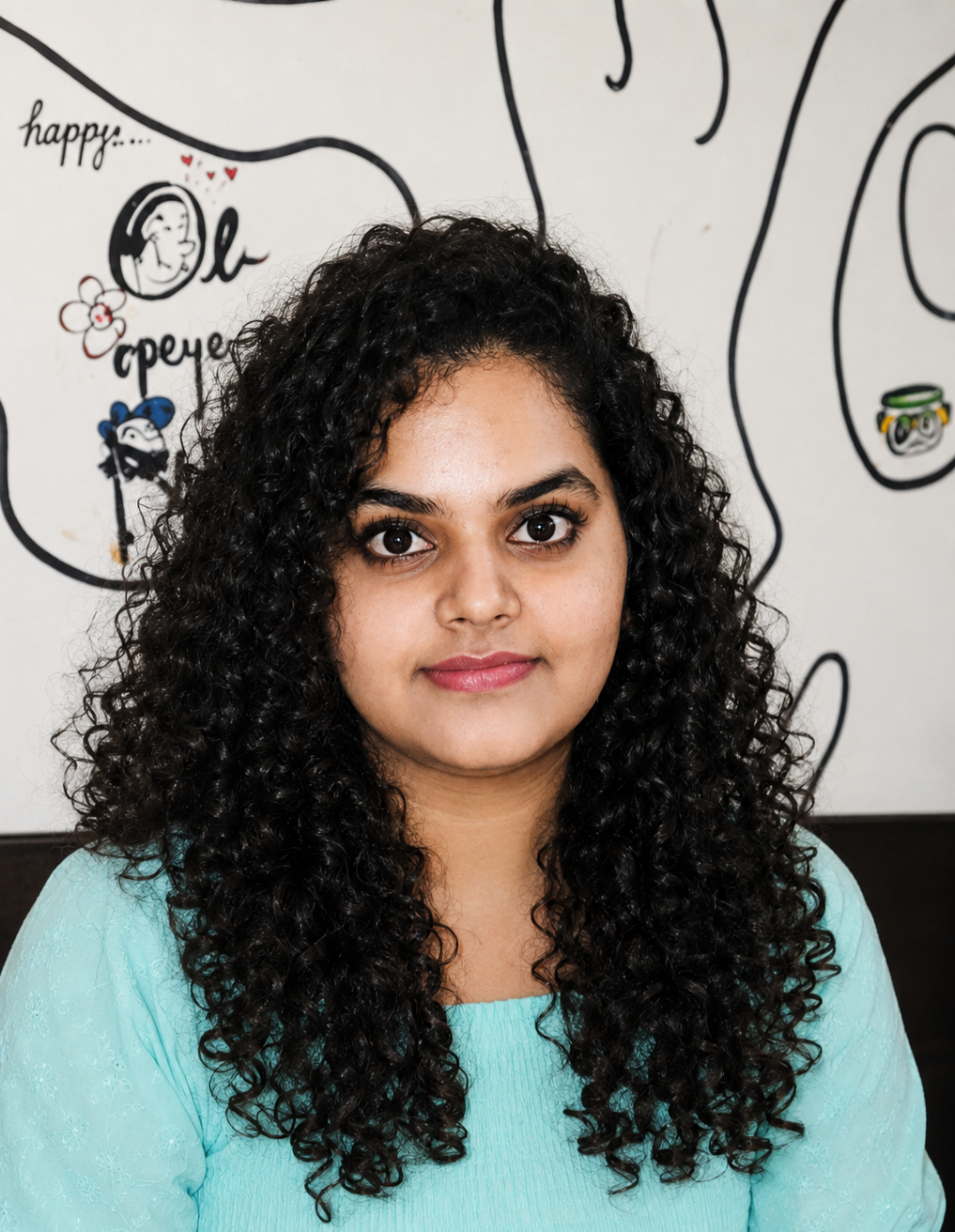
Vaishnavi Pusapati